Nylon Print Temperature Chart
Variant
Brand
2 PA6 / PA6-66 (unfilled) sources: nozzle 250–290 °C; the window every one of them accepts is 250–270 °C.
Polymaker PolyMide CoPA
PA6 / PA6-66 (unfilled)
- Nozzle
- 250–270 °C
- try first 260 °C
- Bed
- 25–50 °C
- try first 40 °C
- Enclosure / chamber
- Closed, ambient temp
- Part-cooling fan
- Off
- Drying
- 100 °C · 8 h
- Annealing
- 80 °C · 6 h
- Water uptake
- —
- Nozzle type
- Hardened steel
- Print speed
- 50–200 mm/s
- Density
- 1.12 g/cm³
- Heat resistance
- HDT 70 °C @1.8 MPa · HDT 111 °C @0.45 MPa · Vicat 180 °C · Tg 66 °C
Fits your printer
Copolymer of PA6 and PA6,6. Store below 20 % RH. After 48 h in 60 °C water (6.16 % moisture) X-Y tensile strength fell from 78.0 to 34.3 MPa. Polymaker recommends a wear-resistant nozzle because brass wears quickly.
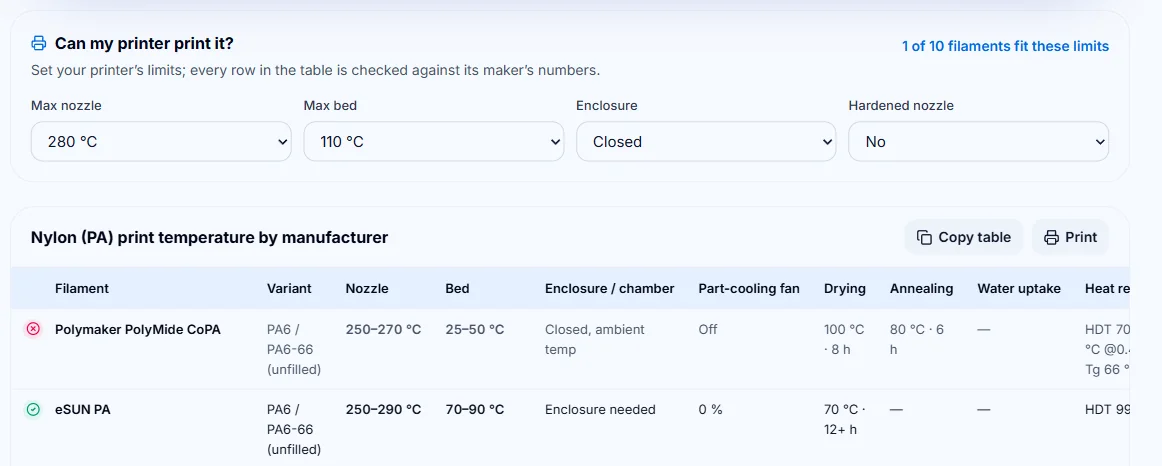
Can my printer print it?
10 of 10 filaments fit these limits
Set your printer’s limits; every row in the table is checked against its maker’s numbers.
Nylon (PA) print temperature by manufacturer
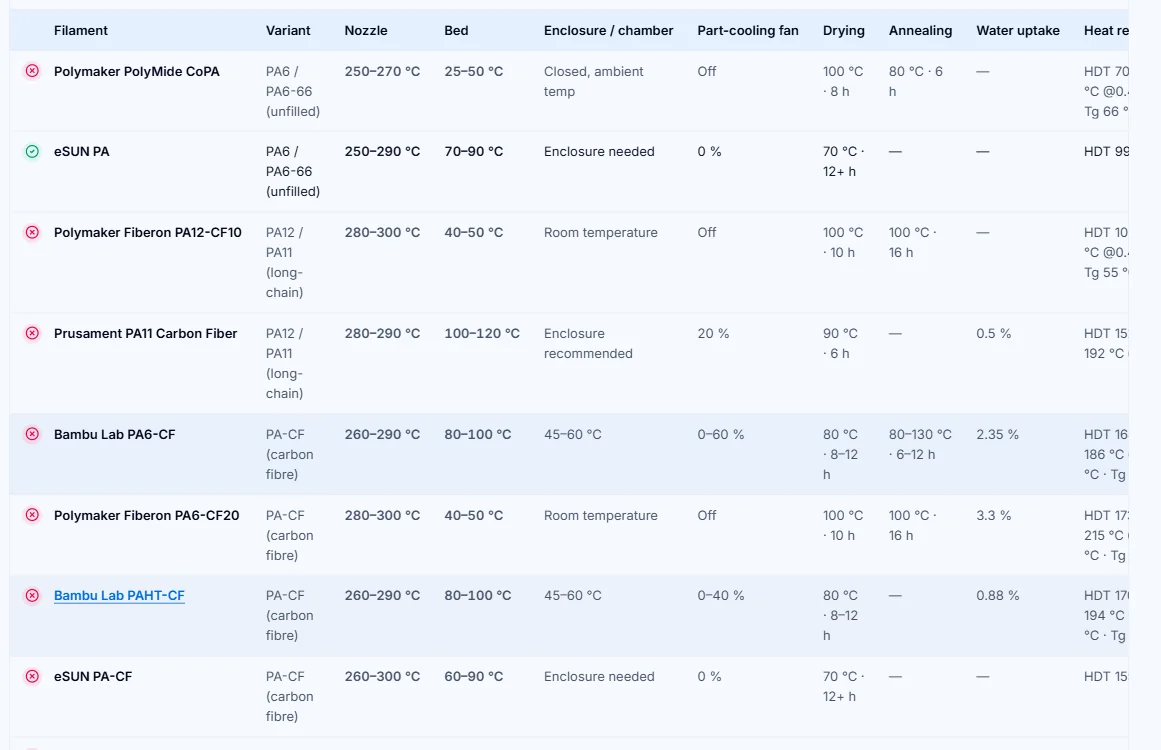
| Can my printer print it? | Filament | Variant | Nozzle | Bed | Enclosure / chamber | Part-cooling fan | Drying | Annealing | Water uptake | Heat resistance | Nozzle type |
|---|---|---|---|---|---|---|---|---|---|---|---|
| OK | Polymaker PolyMide CoPA | PA6 / PA6-66 (unfilled) | 250–270 °C | 25–50 °C | Closed, ambient temp | Off | 100 °C · 8 h | 80 °C · 6 h | — | HDT 70 °C @1.8 MPa · HDT 111 °C @0.45 MPa · Vicat 180 °C · Tg 66 °C | Hardened steel |
| OK | eSUN PA | PA6 / PA6-66 (unfilled) | 250–290 °C | 70–90 °C | Enclosure needed | 0 % | 70 °C · 12+ h | — | — | HDT 99.6 °C (load not stated) | Brass is fine |
| OK | Polymaker Fiberon PA12-CF10 | PA12 / PA11 (long-chain) | 280–300 °C | 40–50 °C | Room temperature | Off | 100 °C · 10 h | 100 °C · 16 h | — | HDT 105 °C @1.8 MPa · HDT 131 °C @0.45 MPa · Vicat 170.2 °C · Tg 55 °C | Hardened steel |
| OK | Prusament PA11 Carbon Fiber | PA12 / PA11 (long-chain) | 280–290 °C | 100–120 °C | Enclosure recommended | 20 % | 90 °C · 6 h | — | 0.5 % | HDT 152 °C @1.8 MPa · HDT 192 °C @0.45 MPa | Hardened steel |
| OK | Bambu Lab PA6-CF | PA-CF (carbon fibre) | 260–290 °C | 80–100 °C | 45–60 °C | 0–60 % | 80 °C · 8–12 h | 80–130 °C · 6–12 h | 2.35 % | HDT 164 °C @1.8 MPa · HDT 186 °C @0.45 MPa · Vicat 212 °C · Tg 68 °C | Hardened steel |
| OK | Polymaker Fiberon PA6-CF20 | PA-CF (carbon fibre) | 280–300 °C | 40–50 °C | Room temperature | Off | 100 °C · 10 h | 100 °C · 16 h | 3.3 % | HDT 173 °C @1.8 MPa · HDT 215 °C @0.45 MPa · Vicat 219.2 °C · Tg 74.2 °C | Hardened steel |
| OK | Bambu Lab PAHT-CF | PA-CF (carbon fibre) | 260–290 °C | 80–100 °C | 45–60 °C | 0–40 % | 80 °C · 8–12 h | — | 0.88 % | HDT 170 °C @1.8 MPa · HDT 194 °C @0.45 MPa · Vicat 220 °C · Tg 70 °C | Hardened steel |
| OK | eSUN PA-CF | PA-CF (carbon fibre) | 260–300 °C | 60–90 °C | Enclosure needed | 0 % | 70 °C · 12+ h | — | — | HDT 155 °C (load not stated) | Hardened steel |
| OK | Bambu Lab PA6-GF | PA-GF (glass fibre) | 260–290 °C | 80–100 °C | 45–60 °C | 0–60 % | 80 °C · 8–12 h | 80–130 °C · 6–12 h | 2.56 % | HDT 158 °C @1.8 MPa · HDT 182 °C @0.45 MPa · Vicat 210 °C · Tg 67 °C | Hardened steel |
| OK | Polymaker Fiberon PA6-GF25 | PA-GF (glass fibre) | 280–300 °C | 40–50 °C | Room temperature | Off | 100 °C · 10 h | 100 °C · 16 h | 3.33 % | HDT 157 °C @1.8 MPa · HDT 191 °C @0.45 MPa · Vicat 211.7 °C · Tg 70.4 °C | Hardened steel |
Values copied from each manufacturer’s datasheet or official page, checked 2026-11-24. The label on your spool wins if it differs.
- Drying settings for every grade
- PA6, PA12, PA-CF and PA-GF
- Copy or print the table
- Moisture and warping fixes
Nylon is about water as much as heat
The nozzle range is wide, but the number that ruins most nylon prints is the moisture in the spool.
- 250–300 °Cnozzle range across ten nylon datasheets
- 70–100 °Cdrying temperatures the makers publish
- 78 → 34 MPaPolyMide CoPA tensile strength, dry vs wet
Printing nylon in four steps
Dry first, print hot, keep the spool dry while it prints. The recording shows the chart switching between nylon types and the printer check.
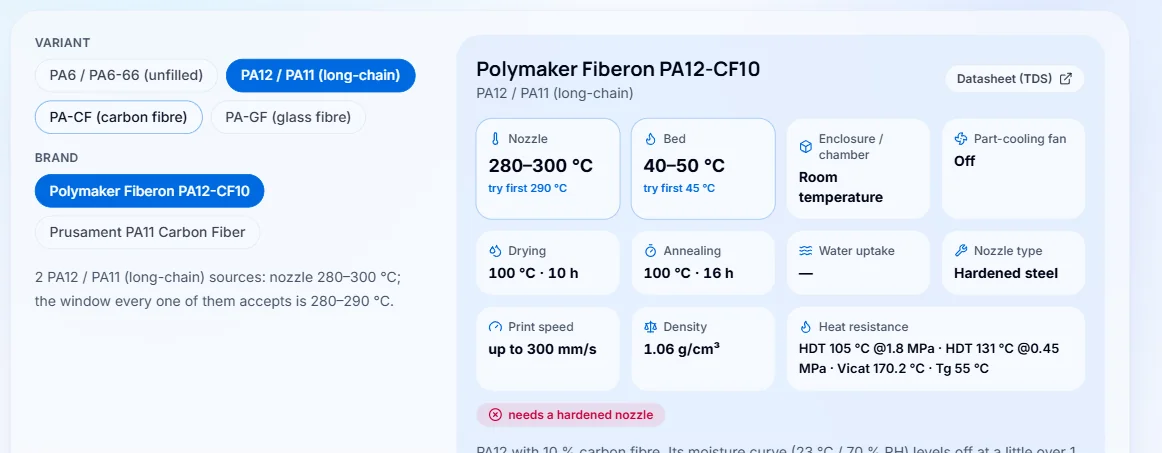
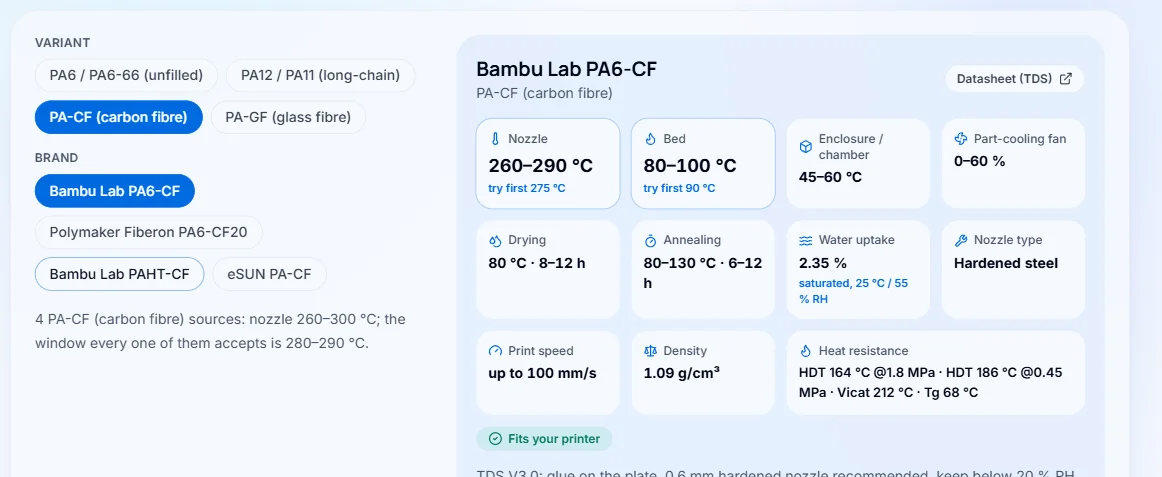
Pick the nylon type, then the brand
PA6, PA12 / PA11, PA-CF or PA-GF. The card shows nozzle and bed with a first value, plus drying, annealing, water uptake and nozzle type.
Check your printer against it
Nylon needs 250 °C or more at the nozzle and most fibre grades need a hardened nozzle. The printer check marks what your machine cannot do.
Dry the spool at the listed setting
From 70 °C for 12 h or more (eSUN) to 100 °C for 8–10 h (Polymaker). Print from a sealed box kept below 20 % RH.
Print, then anneal if the datasheet says so
Several grades list an annealing step, from 80 °C for 6 h to 100 °C for 16 h, which raises stiffness and heat resistance.
Four kinds of nylon, four sets of numbers
“Nylon” covers very different filaments. The base polyamide and the filler decide the temperatures.
Nylon (PA) · nozzle temperature by variant
- PA6 / PA6-66 (unfilled)250–290 °C
- PA12 / PA11 (long-chain)280–300 °C
- PA-CF (carbon fibre)260–300 °C
- PA-GF (glass fibre)260–300 °C
Nylon (PA) · bed temperature by variant
- PA6 / PA6-66 (unfilled)25–90 °C
- PA12 / PA11 (long-chain)40–120 °C
- PA-CF (carbon fibre)40–100 °C
- PA-GF (glass fibre)40–100 °C
Nylon (PA) set-up at a glance · PA6 / PA6-66 (unfilled)
Unfilled PA6 / PA6-66: 250–270 °C
Polymaker PolyMide CoPA (a PA6/PA6,6 copolymer) lists 250–270 °C and eSUN PA 250–290 °C, so 250–270 °C fits both. Beds differ a lot: 25–50 °C for PolyMide, 70–90 °C for eSUN. Unfilled nylon warps the most, so an enclosure helps.
PA12 and PA11: lower water uptake
Long-chain nylons absorb less water. Fiberon PA12-CF10 prints at 280–300 °C and its moisture curve levels off a little above 1 %. Prusament PA11 Carbon Fiber prints at 285 ± 5 °C and absorbs 0.50 % in seven days at 22 % RH.
PA-CF: hotter, stiffer, abrasive
Carbon-fibre nylon runs at 260–300 °C. Bambu PA6-CF and PAHT-CF list 260–290 °C with a 45–60 °C chamber; Fiberon PA6-CF20 280–300 °C; eSUN PA-CF 260–300 °C. All need a hardened nozzle.
PA-GF: glass fibre, same heat
Bambu PA6-GF lists 260–290 °C, Fiberon PA6-GF25 280–300 °C. Glass fibre gives stiffness and dimensional stability like carbon fibre, and it is just as hard on brass nozzles.
Bed temperature depends on the formula
Bambu’s nylons want 80–100 °C with glue, Prusament PA11 CF 110 ± 10 °C on its special PA sheet. Polymaker’s Fiberon grades only need 40–50 °C and a room-temperature chamber: Polymaker says its formulation lets larger nylon parts print on open-frame printers.
Drying is not optional
Prusa warns that badly stored polyamide can absorb water up to 10 % of the filament’s weight, and that wet nylon prints with bubbles and uneven layers. Every datasheet here lists a drying step, and Bambu and Polymaker ask for storage below 20 % RH.
PA6 vs PA12 vs PA-CF vs PA-GF settings
Ranges span every datasheet of that type in the chart. Water uptake is quoted with each maker’s own test condition.
PA6 / PA6-66 (unfilled)
- Nozzle
- 250–290 °C
- Bed
- 25–90 °C
- HDT 1.8 MPa
- 70 °C
- Enclosure
- closed
- Hardened nozzle
- yes
PA12 / PA11 (long-chain)
- Nozzle
- 280–300 °C
- Bed
- 40–120 °C
- HDT 1.8 MPa
- 105–152 °C
- Enclosure
- closed
- Hardened nozzle
- yes
PA-CF (carbon fibre)
- Nozzle
- 260–300 °C
- Bed
- 40–100 °C
- HDT 1.8 MPa
- 164–173 °C
- Enclosure
- closed
- Hardened nozzle
- yes
PA-GF (glass fibre)
- Nozzle
- 260–300 °C
- Bed
- 40–100 °C
- HDT 1.8 MPa
- 157–158 °C
- Enclosure
- closed
- Hardened nozzle
- yes
| Setting | PA6 / PA6-66 | PA12 / PA11 | PA-CF | PA-GF |
|---|---|---|---|---|
| Nozzle | 250–290 °C | 280–300 °C | 260–300 °C | 260–300 °C |
| Bed | 25–50 °C, 70–90 °C | 40–50 °C, 100–120 °C | 40–100 °C | 40–50 °C, 80–100 °C |
| Enclosure | Closed (both makers) | Room temp. (Fiberon); recommended (Prusament) | 45–60 °C (Bambu); room temp. (Fiberon) | 45–60 °C (Bambu); room temp. (Fiberon) |
| Drying | 100 °C 8 h; 70 °C 12 h+ | 100 °C 10 h; 90 °C 6 h | 70–100 °C, 8–12 h+ | 80 °C 8–12 h; 100 °C 10 h |
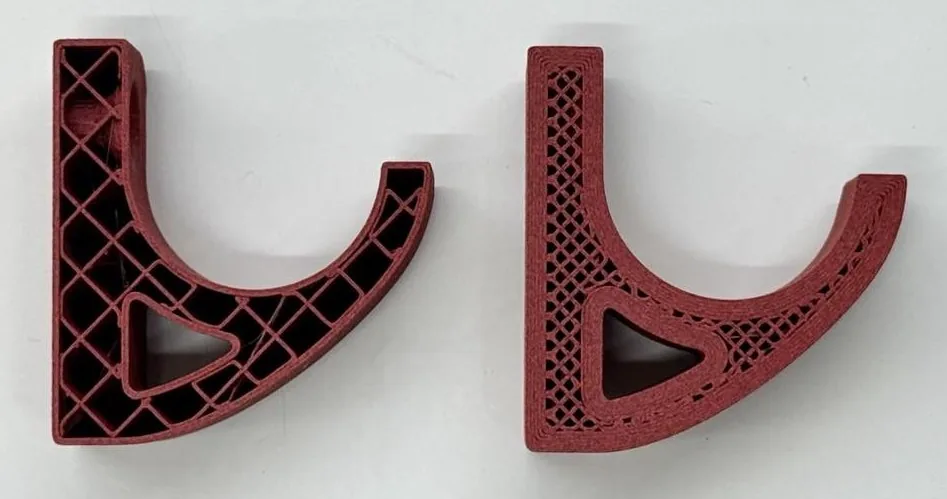
| Annealing | 80 °C 6 h (PolyMide) | 100 °C 16 h (Fiberon) | 80–130 °C 6–12 h; 100 °C 16 h | 80–130 °C 6–12 h; 100 °C 16 h |
| Water uptake | 6.16 % after a 60 °C soak (PolyMide) | 0.50 % in 7 days (PA11 CF) | 0.88–3.3 % | 2.56–3.33 % |
| HDT at 1.8 MPa | 70 °C (PolyMide) | 105 °C, 152 °C | 164–173 °C | 157–158 °C |
| Nozzle type | Wear-resistant advised (Polymaker) | Hardened steel | Hardened steel | Hardened steel |
Water uptake figures use different tests (saturated at 55 % RH, equilibrium at 70 % RH, a 7-day test at 22 % RH, or a soak in water), so compare within one brand.
Moisture, fibre and annealing
Three things the datasheets spend more space on than temperature.
What moisture does to a nylon part
DryWet (6.16 % water)Tensile strength X-Y
78 MPa34.3 MPaYoung’s modulus X-Y
2703 MPa724 MPaNotched Charpy X-Y
6.9 kJ/m²27.7 kJ/m²
Polymaker PolyMide CoPA datasheet: specimens annealed, then dried 48 h or soaked 48 h in 60 °C water. Wet nylon gets far softer but much tougher. Wet nylon is a different material
Polymaker tested PolyMide CoPA dry and after soaking: X-Y tensile strength fell from 78.0 to 34.3 MPa and stiffness to about a quarter, while notched impact strength rose from 6.9 to 27.7 kJ/m². Printed parts keep absorbing water after printing.
Fibre-filled filament and the nozzle
Polymaker’s Fiberon datasheets put the life of a brass nozzle at roughly 9 hours with these filaments. Bambu Lab requires a hardened steel nozzle for PA-CF/GF and recommends 0.6 mm. Fibre eats brass nozzles
Fiberon datasheets say a brass nozzle lasts roughly 9 hours with PA6-CF20, PA6-GF25 or PA12-CF10. Bambu Lab requires hardened steel for PA-CF/GF and recommends a 0.6 mm nozzle to reduce clogging.
Nylon (PA) annealing settings
- Polymaker PolyMide CoPA80 °C · 6 h
- Fiberon PA12-CF10100 °C · 16 h
- Bambu Lab PA6-CF80–130 °C · 6–12 h
- Fiberon PA6-CF20100 °C · 16 h
- Bambu Lab PA6-GF80–130 °C · 6–12 h
- Fiberon PA6-GF25100 °C · 16 h
Annealing temperature and time from each datasheet that publishes one. Parts can shrink or warp in the oven; use an oven with even heat, not a microwave. Annealing finishes the part
Bambu lists 80–130 °C for 6–12 h for PA6-CF and PA6-GF; Fiberon grades 100 °C for 16 h; PolyMide CoPA 80 °C for 6 h. Bambu notes parts may deform, so use an oven with even heat, never a microwave.
Gears, ducts and parts that take a beating
Reference photos from Prusament’s PA11 Carbon Fiber page and Prusa’s nylon and composite guides.
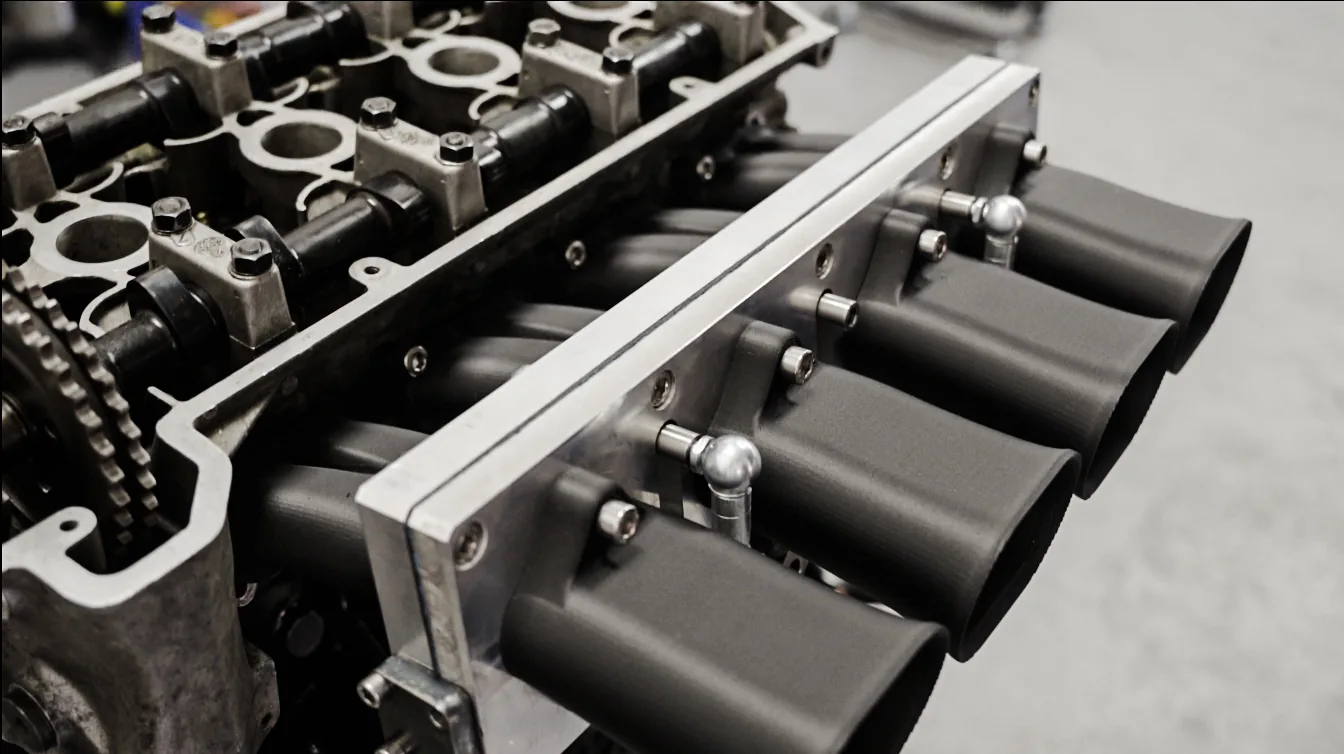
Engine-bay parts
Prusa shows carbon-fibre PA11 intake runners on a real engine. With HDT up to 192 °C at 0.45 MPa, filled nylon is the material for heat near motors.
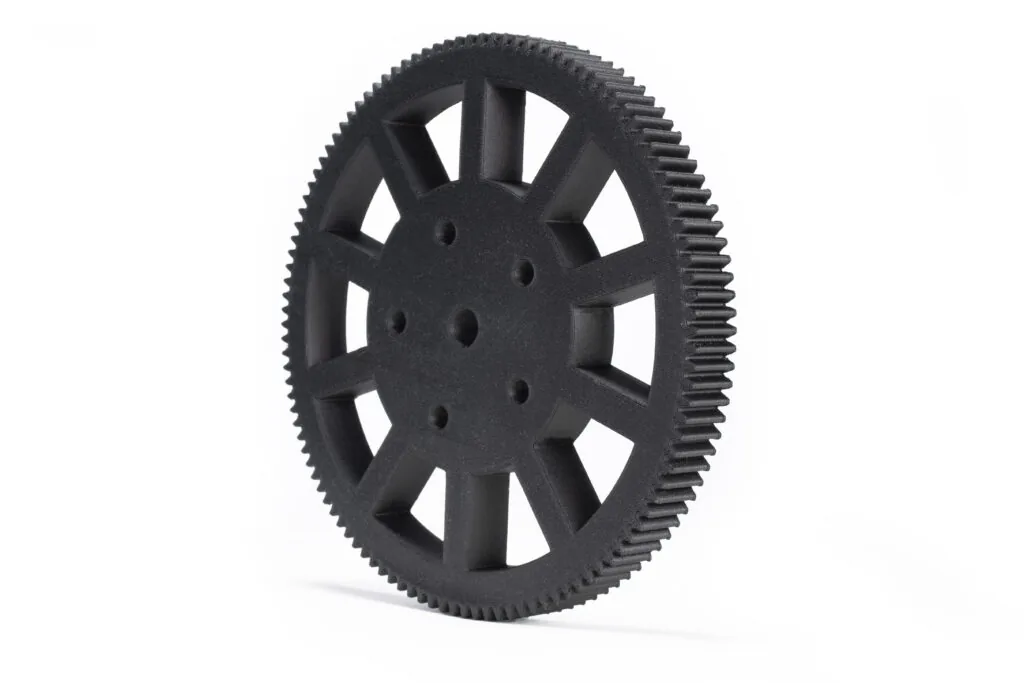
Gears and pulleys
Nylon’s low friction and toughness make it the classic gear material. Print gears from dry filament and anneal them if the datasheet lists it.
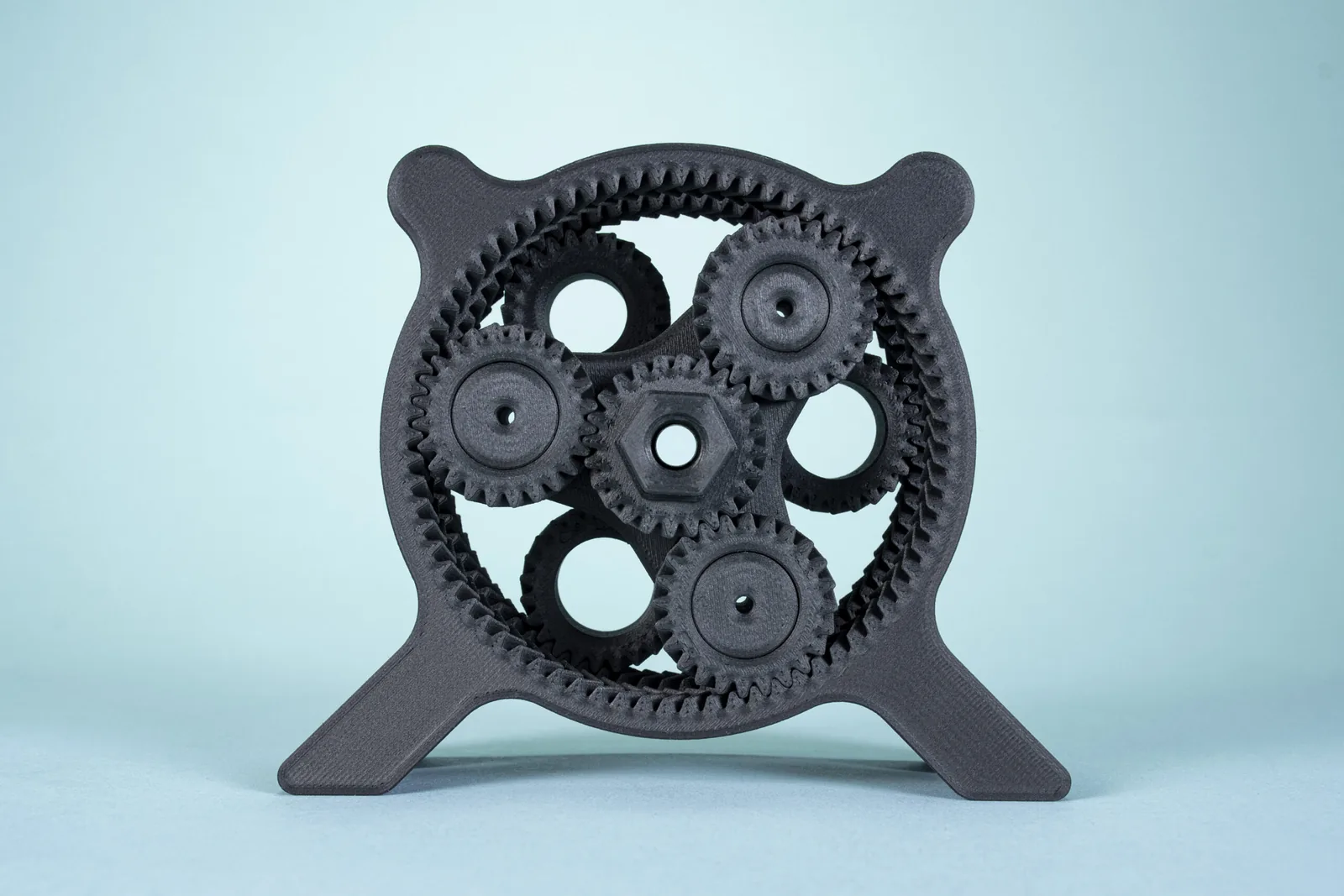
Planetary gearboxes
Multi-part mechanisms need dimensional stability. Fibre-filled grades shrink less than unfilled nylon, so tolerances hold better.
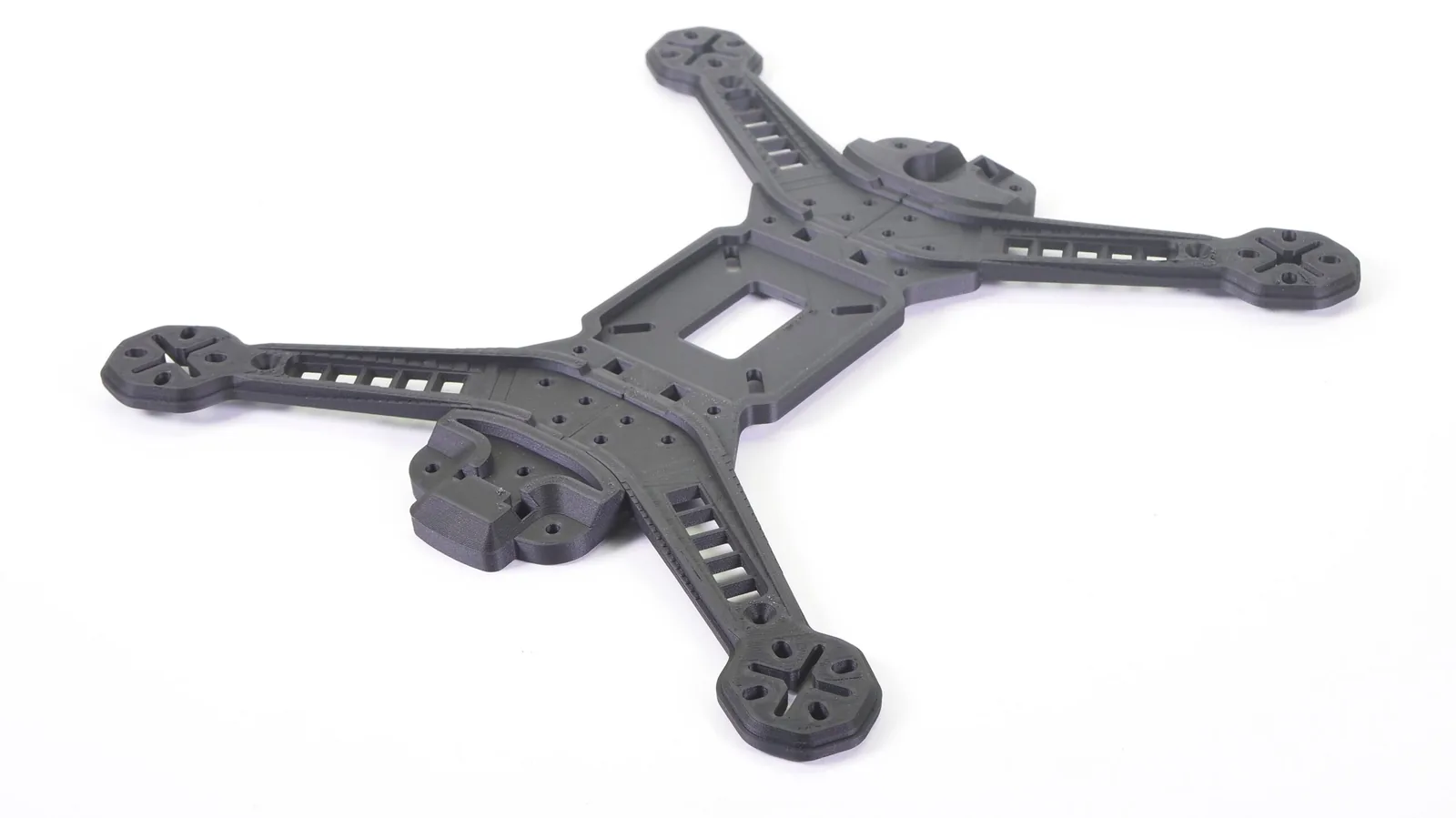
Drone frames
Carbon-fibre composites give stiff, light frames. Keep arms flat on the plate and use glue where the datasheet asks for it.
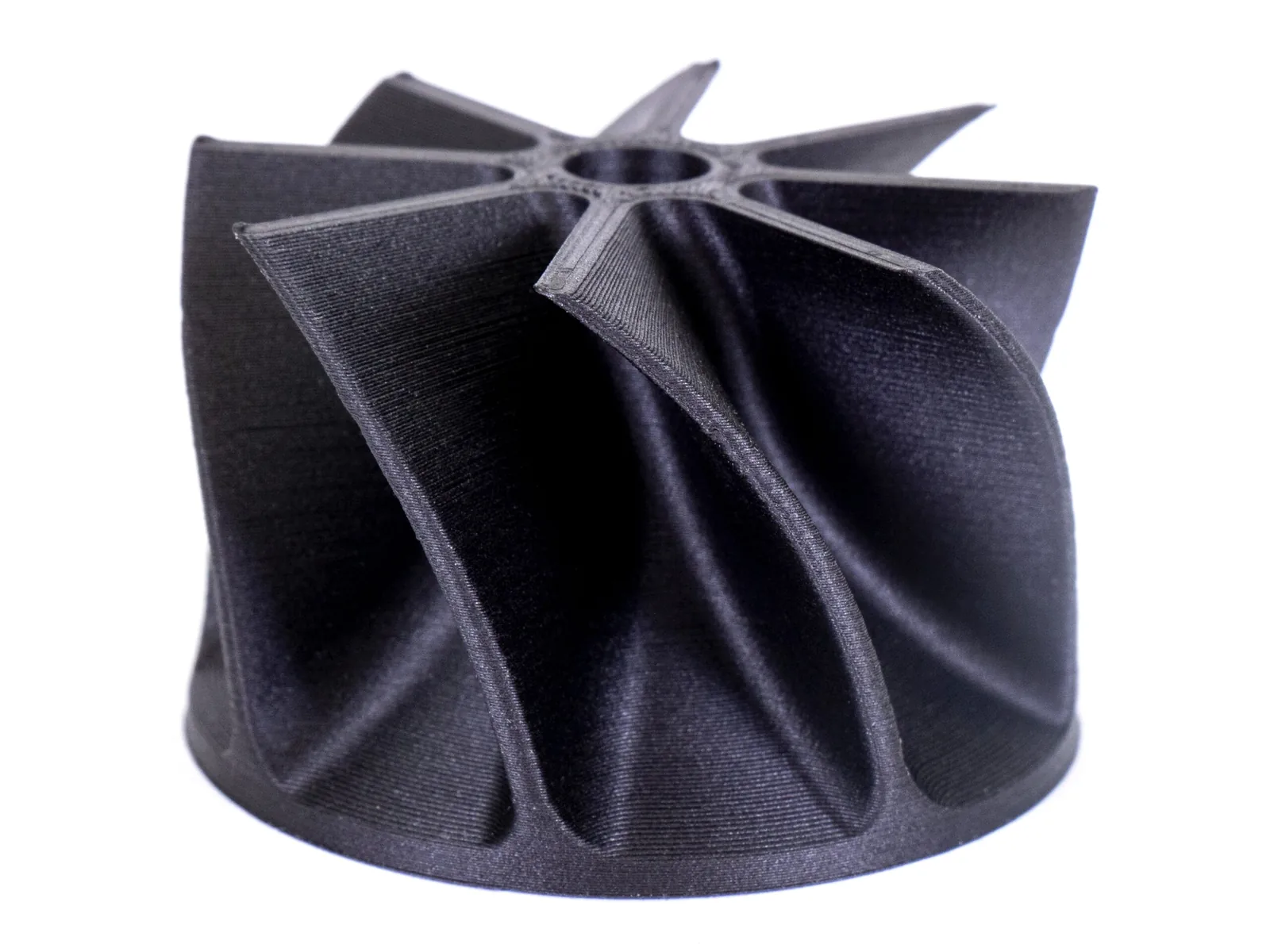
Impellers and fans
Thin, curved blades need a hot nozzle and slow outer walls. A 0.6 mm hardened nozzle is the safe choice for fibre grades.
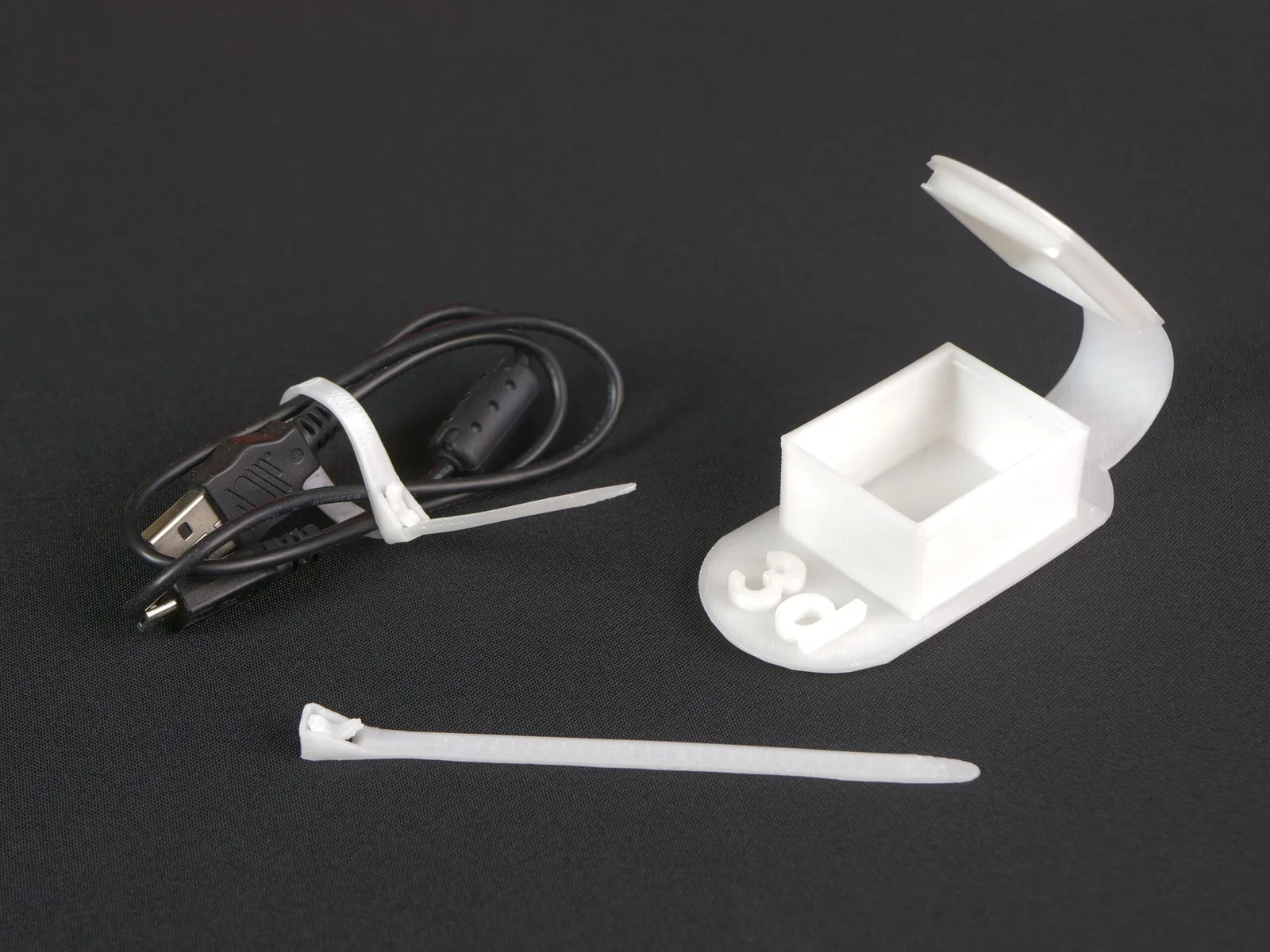
Flexible clips and ties
Prusa notes nylon stays flexible in thin sections. Unfilled nylon suits living hinges, cable ties and snap clips.
Nylon problems by symptom
Most nylon failures trace back to water in the filament or a part cooling unevenly.
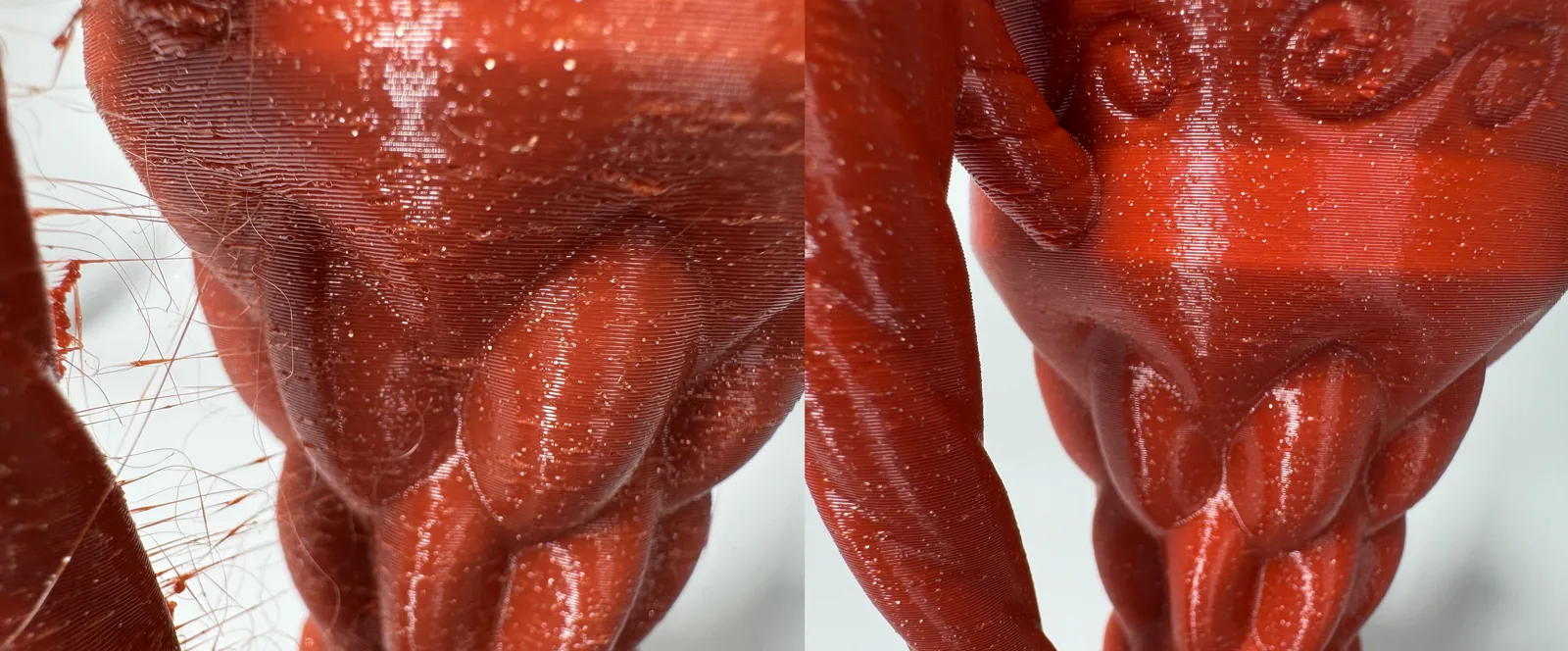 01
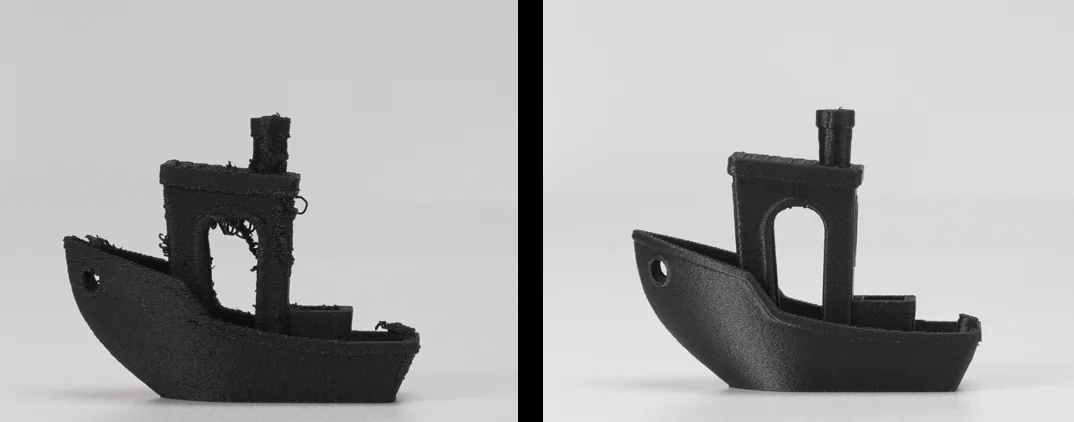
Popping, bubbles and stringing
Root cause: Water in the filament boils in the hot nozzle.
What helps
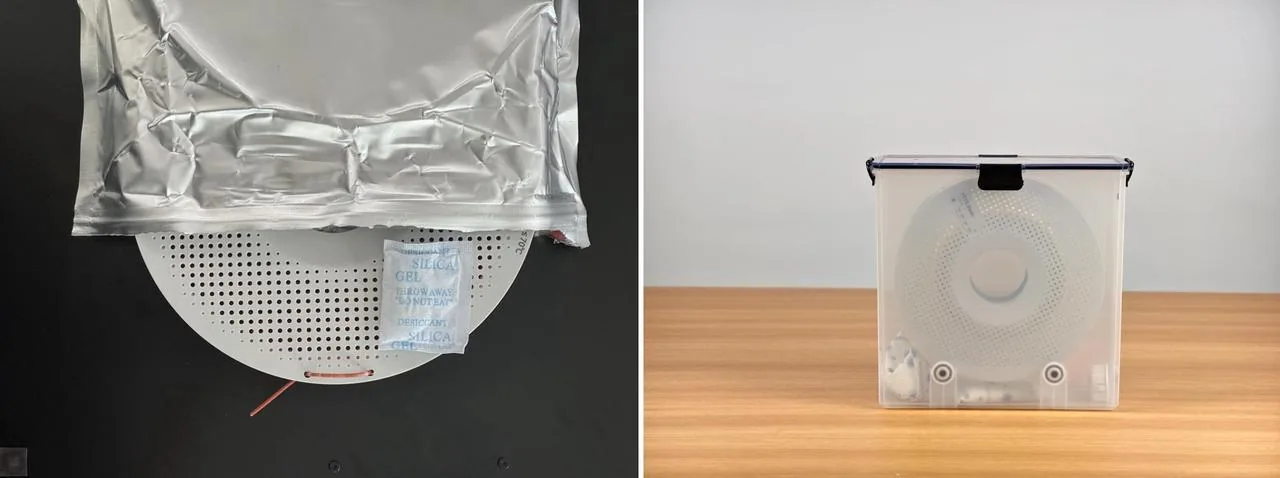
- Dry at the datasheet setting (e.g. Bambu 80 °C 8–12 h, Polymaker 100 °C 8–10 h).
- Print from a sealed dry box below 20 % RH.
- Never leave nylon on the printer overnight.
 02
Rough, fuzzy carbon-fibre prints
Root cause: Damp CF nylon extrudes unevenly and strings between features.
What helps
- Dry before every long print.
- Use a 0.6 mm hardened nozzle, as Bambu recommends.
- Keep speeds within the datasheet limit (Bambu: under 100 mm/s).
 03
Weak layers that split by hand
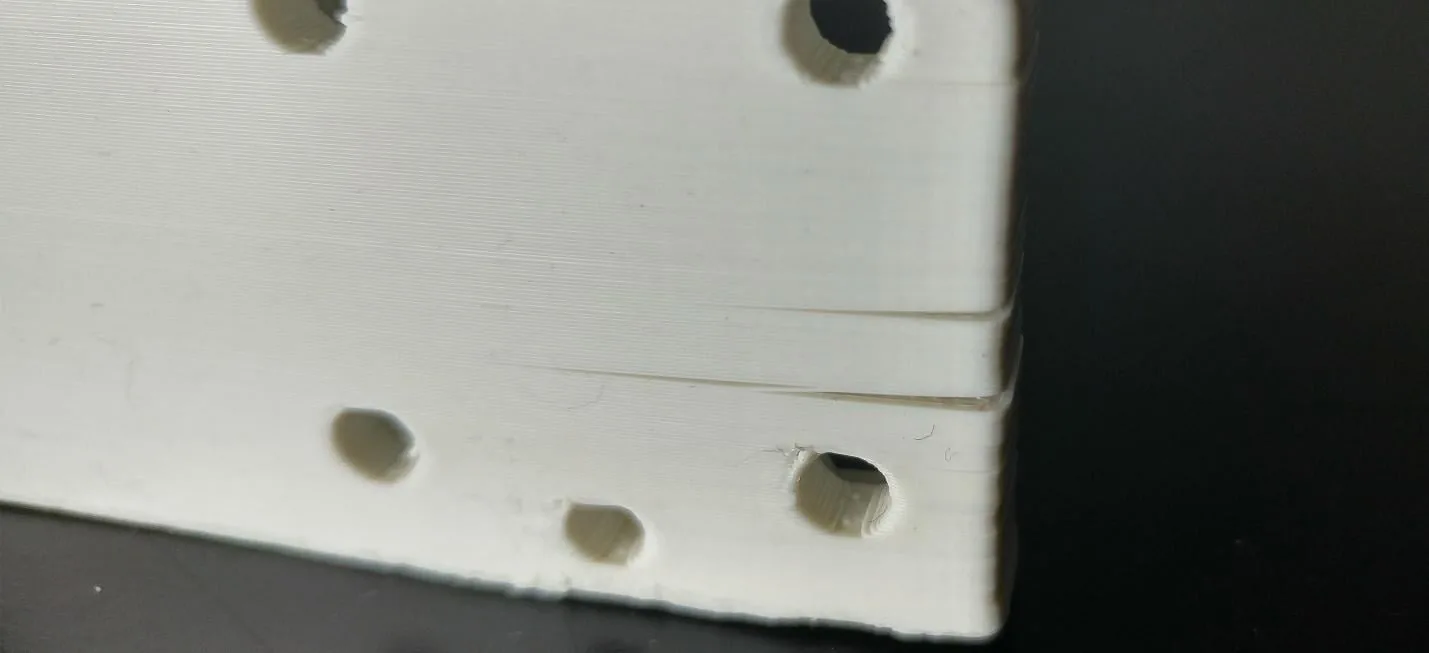
Root cause: Nozzle too cool, too much fan, or wet filament.
What helps
- Print toward the top of the nozzle range.
- Fan off or low (Polymaker and eSUN: off).
- Dry the spool; check layer bonding on a test bar.
Why corners lift
Hot layers shrink as they cool. If the air above the part is much colder than the bed, the upper layers pull harder than the bed can hold. Corners lifting on unfilled nylon
Root cause: Unfilled PA shrinks strongly as it cools.
What helps
- Use an enclosure; eSUN and Polymaker both ask for one.
- Use the plate and glue the maker lists (Prusa: PA Nylon sheet).
- Switch to a CF or GF grade, which shrinks less.
 05
Filament snapping in the feeder
Root cause: Fibre-filled nylon is brittle, especially once it has dried out or been bent tightly.
What helps
- Feed it on a smooth, wide path.
- Bambu lists other brands’ PA-CF/GF as too brittle for its AMS units.
- Store sealed so it does not swing between wet and dry.
Nylon (PA) water uptake by datasheet
- Fiberon PA6-GF25 · equilibrium3.33 %
- Fiberon PA6-CF20 · equilibrium3.3 %
- Bambu Lab PA6-GF · saturated2.56 %
- Bambu Lab PA6-CF · saturated2.35 %
- Bambu Lab PAHT-CF · saturated0.88 %
- Prusament PA11 Carbon Fiber · after 7 days0.5 %
Each maker tests differently (saturated at 55 % RH, equilibrium at 70 % RH, or 7 days at 22 % RH), so compare within one brand first. Products without a published figure are left out. Parts get softer after a few weeks
Root cause: Printed nylon keeps absorbing moisture from the air.
What helps
- Design for the wet stiffness, not the dry one.
- Prefer PA12, PA11 or PAHT-CF where humidity is high.
- Anneal and condition parts before measuring them.
Sources for the nylon chart
Read from these manufacturer documents on 2026-11-24. Where one field comes from a second official page, both are listed.
- Polymaker PolyMide CoPA — Datasheet (TDS)
- eSUN PA — Official product page
- Polymaker Fiberon PA12-CF10 — Datasheet (TDS)
- Prusament PA11 Carbon Fiber — Datasheet (TDS)
- Prusament PA11 Carbon Fiber product page
- Prusa Knowledge Base — Drying filament
- Bambu Lab PA6-CF — Datasheet (TDS)
- Polymaker Fiberon PA6-CF20 — Datasheet (TDS)
- Bambu Lab PAHT-CF — Datasheet (TDS)
- eSUN PA-CF — Official product page
- Bambu Lab PA6-GF — Datasheet (TDS)
- Polymaker Fiberon PA6-GF25 — Datasheet (TDS)
Why use this nylon temperature chart
Ten datasheets, sorted by nylon type, with the drying and water data nylon really needs.
Every value has a source
Each row links to the datasheet or product page it came from. Nothing is averaged; a field the maker does not publish shows as a dash.
Nylon (PA) drying: temperature and time
- Polymaker PolyMide CoPA100 °C · 8 h
- Fiberon PA12-CF10100 °C · 10 h
- Fiberon PA6-CF20100 °C · 10 h
- Fiberon PA6-GF25100 °C · 10 h
- Prusament PA11 Carbon Fiber90 °C · 6 h
- Bambu Lab PA6-CF80 °C · 8–12 h
- Bambu Lab PAHT-CF80 °C · 8–12 h
- Bambu Lab PA6-GF80 °C · 8–12 h
- eSUN PA70 °C · 12+ h
- eSUN PA-CF70 °C · 12+ h
Bar length is the drying temperature; the label adds the hours. “+” means “at least”. Drying settings for every grade
Temperature and hours from each maker, from 70 °C for 12 h or more to 100 °C for 10 h, in one view.
Checks your printer
Enter max nozzle, max bed, enclosure and nozzle type to see which PA6, PA12, PA-CF and PA-GF grades your printer can run.
PA6, PA12, CF and GF apart
The chart separates the base nylon and the filler, because they change the nozzle, bed and water uptake.
Nylon (PA) heat deflection, 1.8 MPa
- Fiberon PA6-CF20173 °C
- Bambu Lab PAHT-CF170 °C
- Bambu Lab PA6-CF164 °C
- Bambu Lab PA6-GF158 °C
- Fiberon PA6-GF25157 °C
- Prusament PA11 Carbon Fiber152 °C
- Fiberon PA12-CF10105 °C
- ABS (Bambu ABS)84 °C
- Polymaker PolyMide CoPA70 °C
- PETG (Bambu PETG Basic)68 °C
- PLA (Bambu PLA Basic)54 °C
HDT at 1.8 MPa (ISO 75) from each datasheet, highest first; grey bars are PLA, PETG and ABS for scale. Products that publish no 1.8 MPa value are left out. Heat resistance side by side
Heat deflection at 1.8 MPa from each datasheet, against PLA, PETG and ABS for scale.
A first value to try
Every range gets a midpoint for a temperature tower, rounded to 5 °C. Copy or print the table for the printer room.
Nylon print temperature FAQ
Nylon questions, answered from manufacturer datasheets.
More ways to work with your 3D files
View, convert, or make a model from scratch.
Polycarbonate Print Temperature
Nozzle, bed and enclosure settings for PC filament.
ASA Print Temperature
Nozzle, bed and enclosure temperatures for ASA.
Filament Length Calculator
Convert filament weight to length and back for any material.
3D Print Cost Calculator
Filament, power and wear cost of one print.
Need a tough part designed first?
Turn a photo into a printable 3D model, then print it in nylon or PA-CF for gears, brackets and parts near heat.