3D Print Cost Calculator
- Files measured in your browser
- No account needed
- 8 currencies
- Shareable link
What the 3D print cost calculator counts
Most calculators stop at filament and power. A real quote also pays for the machine, the prints that fail and the time you spend on each part.
- 6cost lines, each shown with its share
- 7material densities from manufacturer datasheets
- 8currencies, no exchange rates guessed
How to calculate the cost of 3D printing
Three numbers come from your slicer and your bills. The rest are defaults you set once and reuse for every quote.
Enter the filament
Spool price, spool weight and the grams the print uses. No slicer at hand? Drop the STL and the calculator weighs it from volume, walls and infill.
Add time and power
Print hours from the slicer, the printer’s average watts and your price per kWh. Set the printer’s price and lifetime once for wear.
Price it
Add a failure rate, your hands-on minutes and a markup. Read the cost per print, per part and the suggested price, then copy a link to keep the quote.
Every line of the 3D printing cost formula
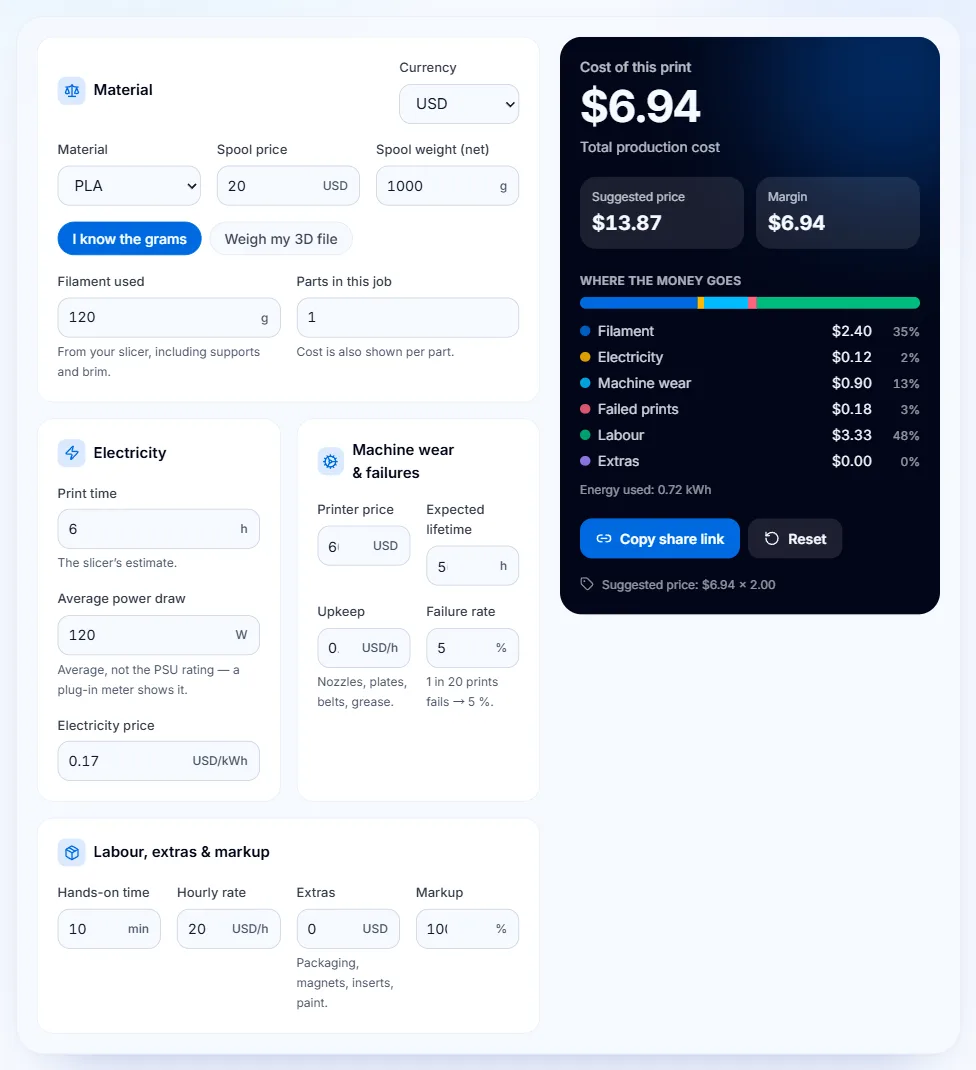
Nothing hidden: these are the exact formulas the calculator runs. The example column is the default job, a 120 g PLA print that takes 6 hours.
Where the money goes
- Filament$2.4035 %
- Electricity$0.122 %
- Machine wear$0.9013 %
- Failed prints$0.183 %
- Labour$3.3348 %
Price at 100 % markup$13.87
Extra cost from failed prints
| Cost line | Formula | Default example |
|---|---|---|
| Filament | grams used ÷ spool grams × spool price | 120 ÷ 1000 × $20 = $2.40 |
| Electricity | watts ÷ 1000 × hours × price per kWh | 0.12 kW × 6 h × $0.17 = $0.12 |
| Machine wear | (printer price ÷ lifetime hours + upkeep per hour) × hours | ($600 ÷ 5000 + $0.03) × 6 = $0.90 |
| Failed prints | (filament + electricity + wear) × f ÷ (1 − f) | $3.42 × 0.05 ÷ 0.95 = $0.18 |
| Labour | minutes ÷ 60 × hourly rate | 10 ÷ 60 × $20 = $3.33 |
| Selling price | total cost × (1 + markup) | $6.94 × 2 = $13.87 |
Why f ÷ (1 − f) and not just f? If 5 % of attempts fail, every 19 good parts pay for 1 failed one, which adds 5.26 %. The difference grows quickly: at 20 % failures the extra cost is 25 %.
From cost to a price you can quote
The calculator gives you the floor. Here is how people who sell prints usually build on it.
Your time is usually the biggest line
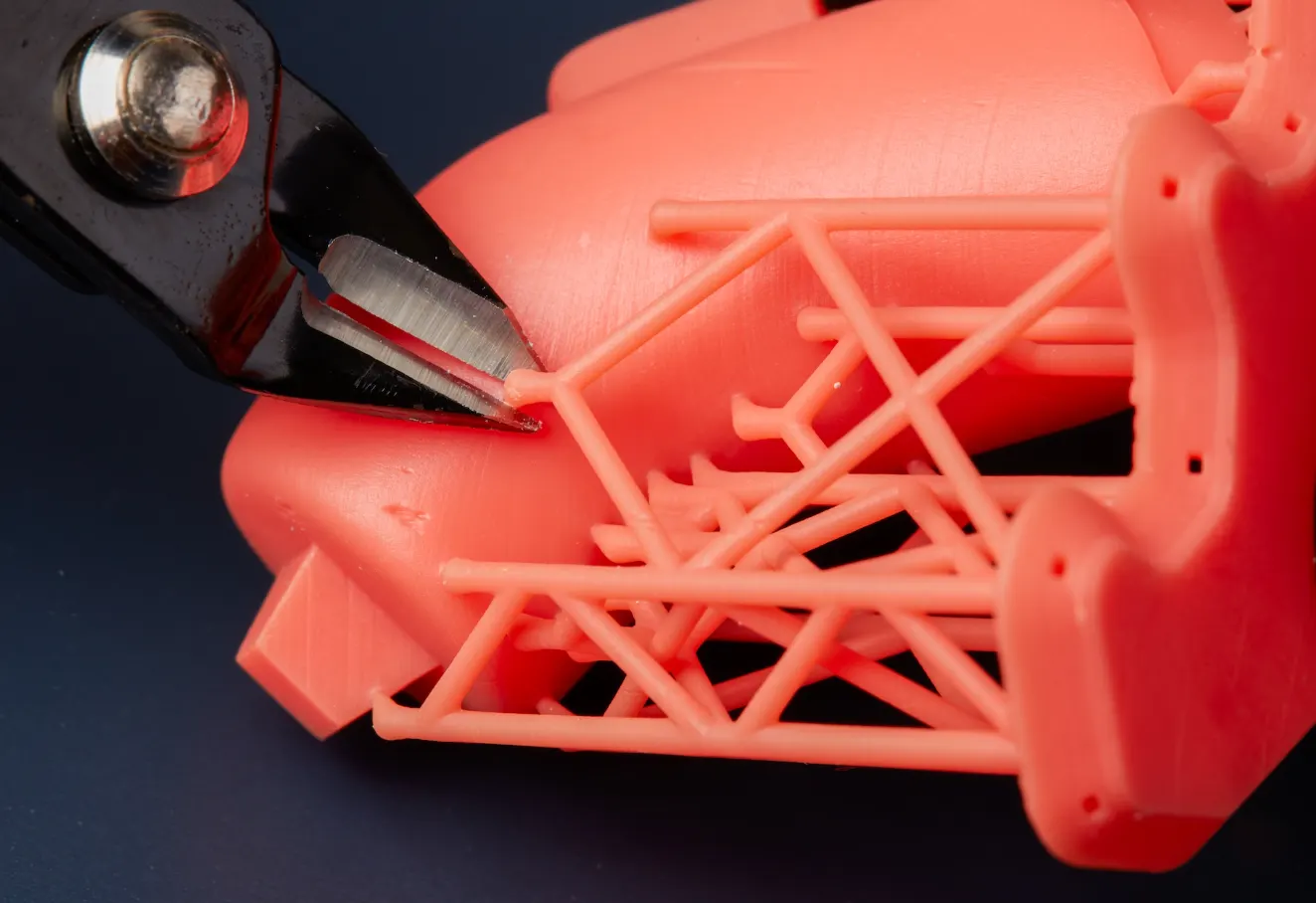
On a small part, filament and power are often less than a dollar, while 10 minutes of removing supports, sanding and packing at $20 an hour is $3.33. Leave labour out and you are working for free.
Markup covers what a single print cannot see
Design time, messages with the customer, marketplace fees, shipping damage and the hours the printer sits idle are not in any one job. A markup of 100 % (price = 2 × cost) is a common starting point; raise it for one-off custom work.
Quote per part, not per plate
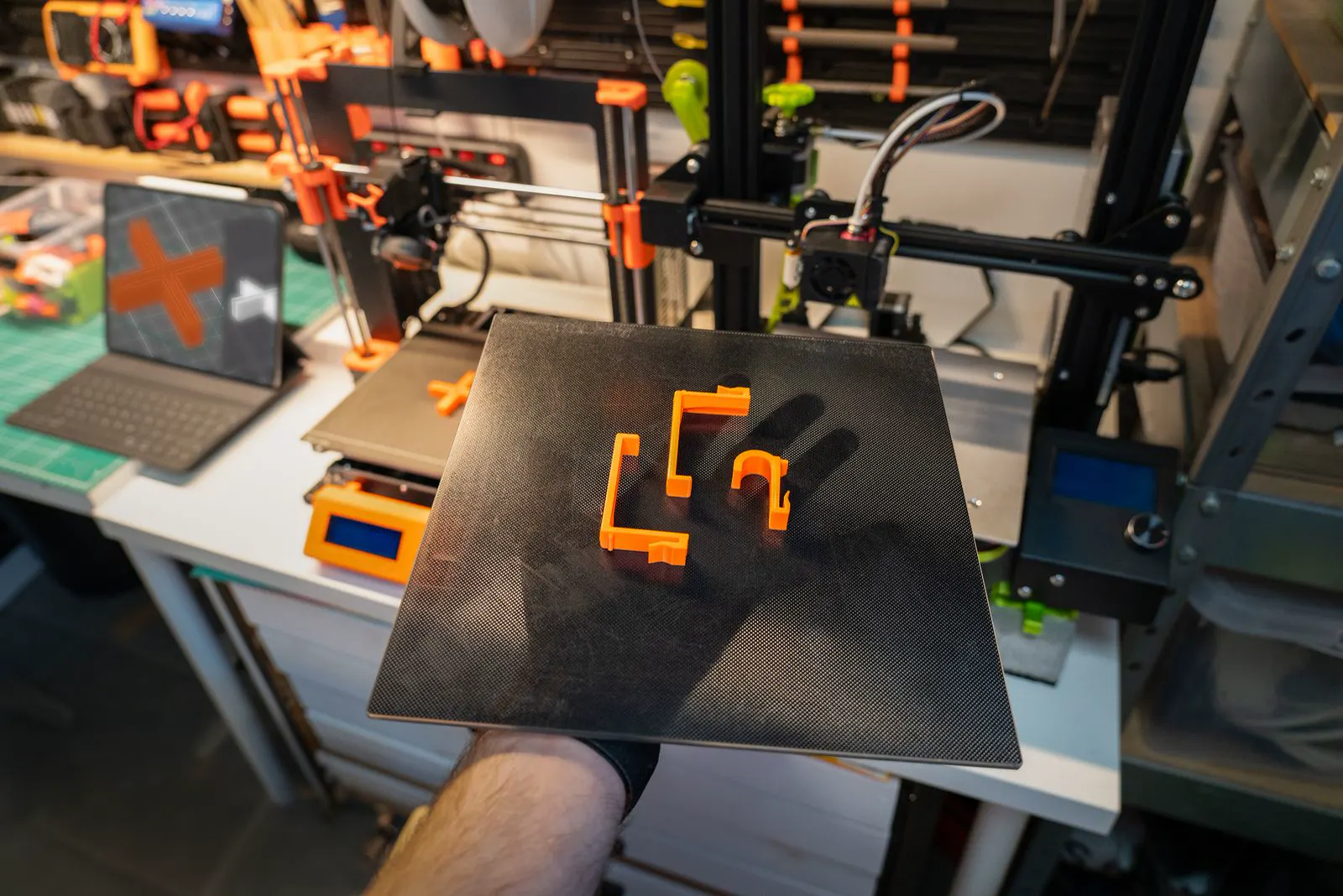
Set "Parts in this job" to the number of good parts on the plate. Ten keychains in one 6-hour print share one warm-up, one plate clean and one failure risk, so each one costs far less than a single keychain printed alone.
Re-check the failure rate every month
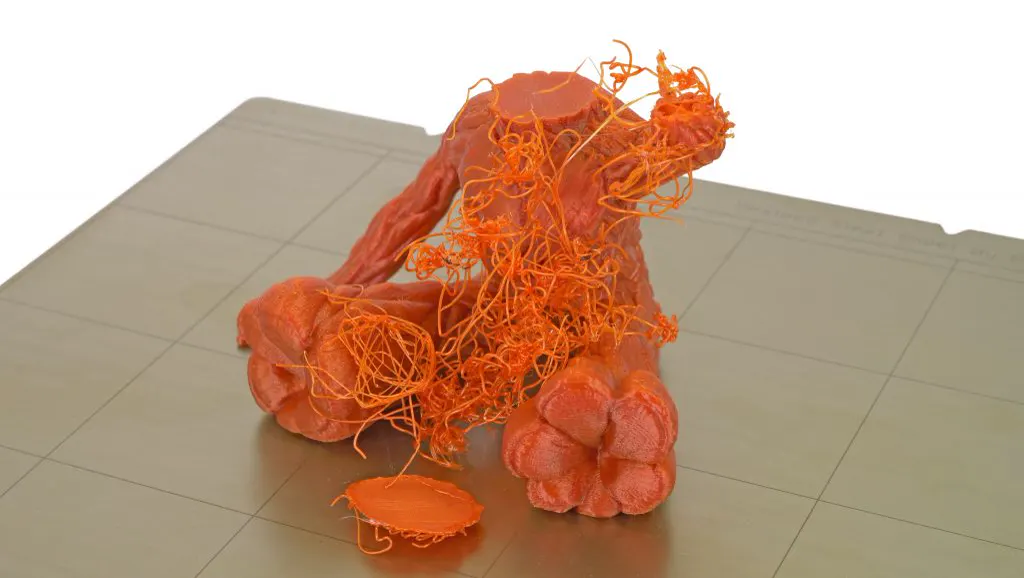
Count the prints that went in the bin. A tuned printer running PLA may fail one print in fifty; a new material, a large flat part or a long multi-colour job fails much more often, and the price should know that.
Material densities used to turn volume into grams
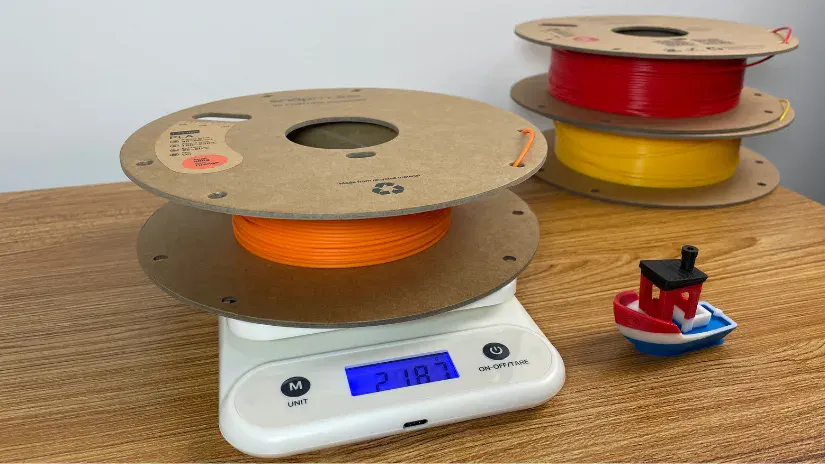
Weighing a 3D file means multiplying the printed volume by the density. The presets are single datasheet values; brands and colours differ, so type your own if your spool’s datasheet says otherwise.
| Material | Density (g/cm³) | Datasheet |
|---|---|---|
| PLA | 1.24 | Bambu Lab PLA Basic TDS (PolyLite PLA: 1.17) |
| PETG | 1.27 | Prusament PETG TDS (Bambu PETG Basic: 1.25) |
| ABS | 1.05 | Bambu Lab ABS TDS (PolyLite ABS: 1.12) |
| ASA | 1.07 | Prusament ASA TDS (Polymaker ASA: 1.13) |
| TPU | 1.22 | Bambu Lab TPU 95A HF TDS (NinjaFlex 85A: 1.19) |
| Nylon (PA) | 1.12 | Polymaker PolyMide CoPA TDS (Prusament PA11: 1.02) |
| Resin | 1.10 | Anycubic Standard Resin V2 TDS lists 1.05–1.25 |
Densities checked against the manufacturers’ datasheets in 2026-11. 1 kg of PLA at 1.24 g/cm³ is about 335 m of 1.75 mm filament.
Why this 3D printing cost calculator
Built for hobbyists checking whether a print is worth it and for sellers who need a defendable price.
Weighs your STL
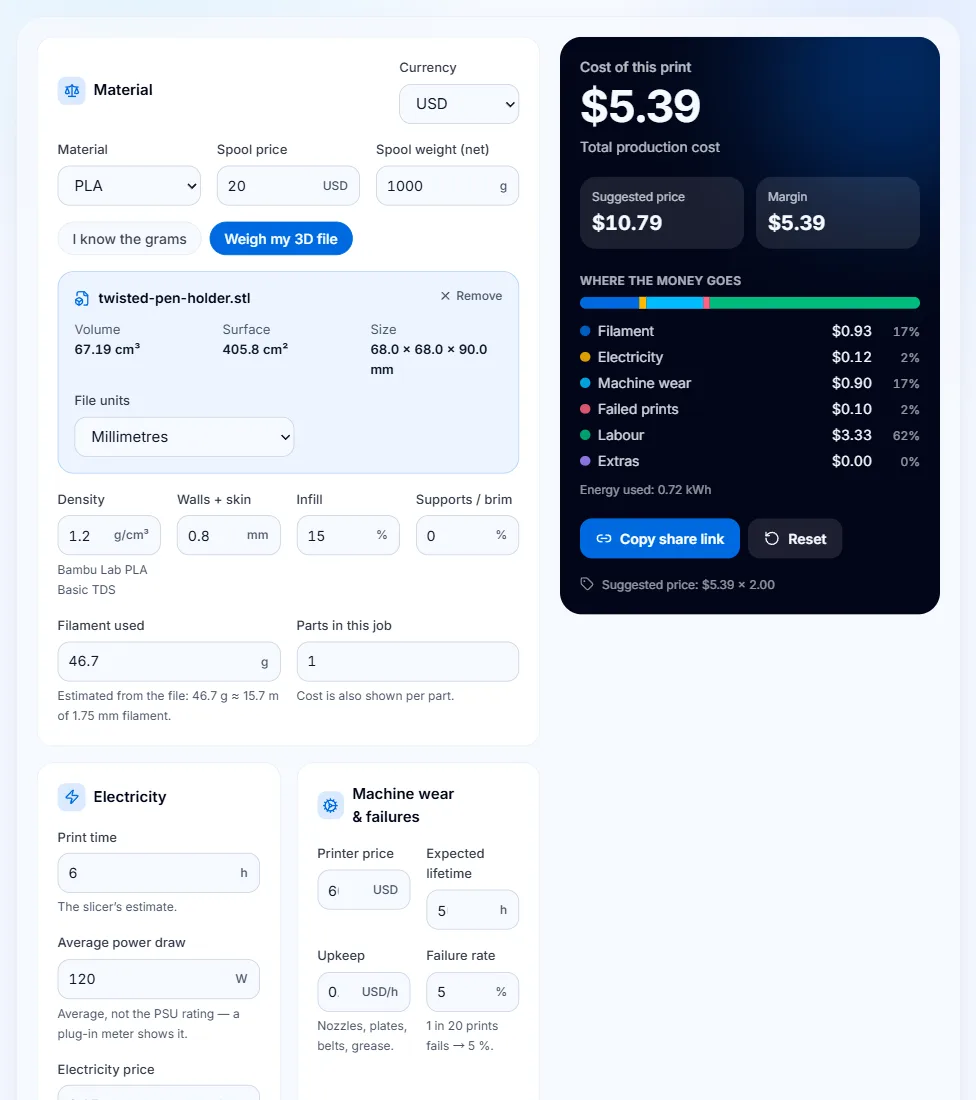
Drop an STL, 3MF, OBJ or GLB. The calculator measures the closed volume and surface, then models walls plus infill to estimate grams and metres of filament.
Counts failed prints properly
Failures are spread over the good parts with f ÷ (1 − f), the expected waste, instead of a flat percentage that undercounts at high failure rates.
Machine wear and upkeep
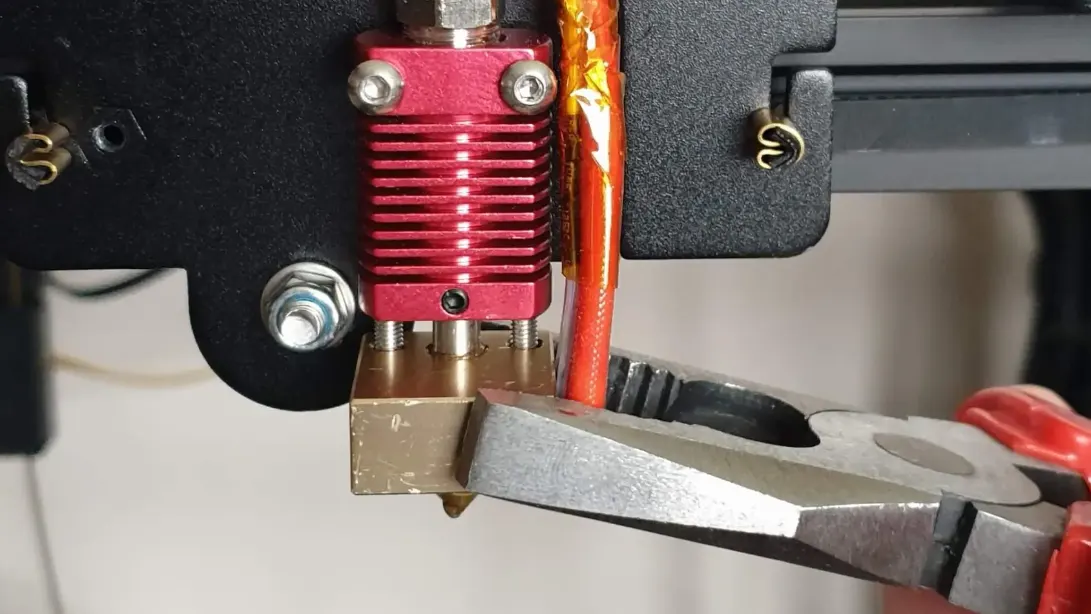
Printer price over its lifetime hours plus spare nozzles and plates per hour, so the next printer is already paid for when this one wears out.

Cost per part and price per part
Print a full plate, enter how many parts it makes, and read the cost and the suggested price of each one.
Your currency, your tariff
Pick USD, EUR, GBP, CNY, JPY, CAD, AUD or INR. Nothing is converted with a guessed exchange rate: you type local prices and see local money.

Share or save a quote
Copy a link that carries every input. Open it later, or send it to a customer, and the same numbers load again. Your 3D file is never part of the link and never leaves your device.
3D print cost calculator FAQ
Questions people ask when they price a print.
More ways to work with your 3D files
View, convert, or make a model from scratch.
No model to price yet?
Turn a photo or a sentence into a printable 3D model, then bring the STL back here to weigh it and work out what it costs.